
”
Written byMatthew Michael
Call Me When You Read This.
Alice Viskat’s “Call Me When You Get This” opened on the 10th of February at the Kaapstad Toneelhuis and, with a fleeting run time, it closed on the 12th of February. The play relied on the audience’s evanescent understanding of how memory becomes fragmented in a game of chance and how we hold on to something that exists in between visits, between time zones, between what is possible, performed and what is promised. What does it mean to have an ocean stand against you? Where stretching one’s arm across the horizon to land on another’s shoulder denounces the distance. Does all of this matter when they call you?
In an unfamiliar way, because I did not watch it, but rather read about it online, this play reminded me of Viskat’s “Black Mouse” from her 2025 National Arts Festival debut. Sayuri Persotham, in her piece titled “The wizardry of Alice Viskat’s playwriting”, written for Grogrotts Mail, describes her approach to setting up serious dialogues as unintentionally funny due to the absurdities of life. In this play, I can attest to a sense of unusual humour found between a loved one’s arms who is poised to leave you standing at the terminal alone.
“The play relied on the audience’s evanescent understanding of how memory becomes fragmented in a game of chance and how we hold on to something that exists in between visits, between time zones, between what is possible, performed and what is promised.”
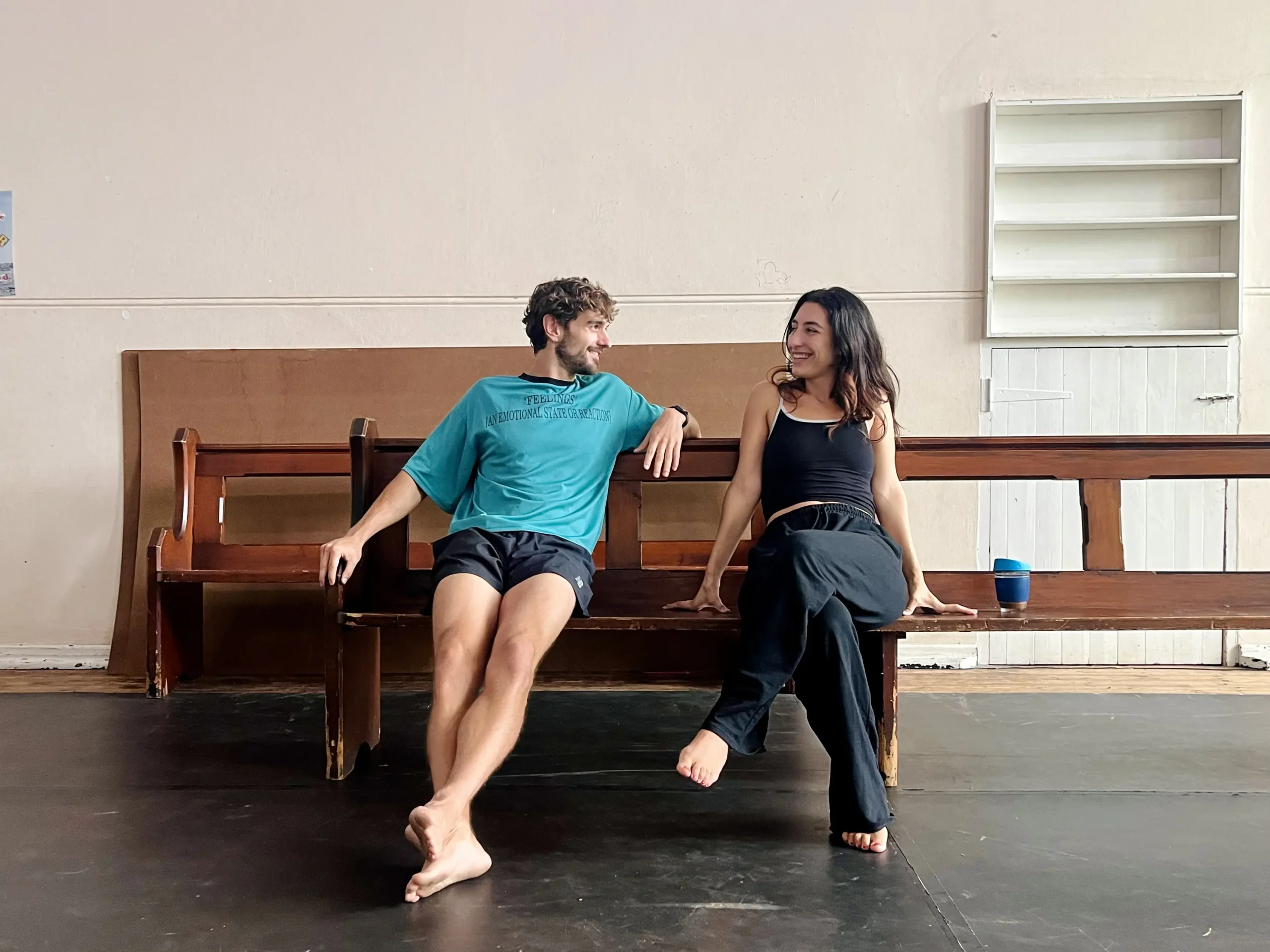
The play begins with an unexpected meeting, a spark between two eyes, first catching a glance of one another. These two unsuspecting characters, played by Evan Hengst and Nicolette Fernandes, fall in love and begin to plan rebellious rendezvous, pursuing their love despite the distance between them. An ocean, in this instance, causes a ruckus in their romantic pursuits. Besotted with each other, they face this challenge with a grit that hardens the viewer’s expectation of commitment. We are shown scattered memories of their relationship, fueled by actors who carry the weight of their words on their lips and the play’s success on their hips. The plot is both complex in its extremities, portraying the limbs one loses in love, yet it repeats itself in the length of its vocation.
Neither of the characters are specifically given a name throughout the performance. We begin to understand, once the play has started and the actors take on their roles, that Viskat’s removal of specificity is rather an access point for a recognizable experience. We cannot project ourselves onto someone with a name, but an actor who holds no name bears the weight of the audience’s experiences. The shambolic set of this particular play was established at the Kaapstad Toneelhuis, whereby the casual intimacy of the arrangement rendered Viskat’s oneiric social assemblage as a romantic gesture. The set dressing surrendered its solemnity for deliberate frivolity, allowing the actors to execute their lines with a charm reserved for when one is in the safety of their home.We understood the structure of the character’s relationship through the intimate placement of various props that reflect transition, such as an unmade bed, which presumably shows how the creases in one’s sheet carry the reflection of whoever slept in it before.
Maybe the caverns made from these duvets are another way to tell how distance becomes remembrance. An unused record player lies idle on a table behind this bed, as if a love song had just played and we, the audience, had missed it. Or a pair of underwear left hanging on the side of the bed, hinting at time passing as we change our outfits to fit our mood. The lighting was dim, nearly intimate in its gesture toward things we do in the dark between lovers; this, in many ways, negated how we, as the audience, were to tell time.
In my understanding, it seemed as though these lovers were caught in a gripping peregrination, rich in detail and informed by twilight. The prosaic nature of this play and its frowzy set meant that the performance relied on the setting; both actors took to their surroundings without hesitation, with an understanding of how we perform love within the structures that surround us. To twirl around a pillar for one’s lover means that we are resolved in our choice of who stands before us. Conveniently, the bar formed part of the performance, serving as a prop for the jocund audience; it also broke the barrier between detached stage performances and a direct, distilled performance that achieved relatability. The space offered for fulfilment, whereby, as a capsule, it illustrated how incomplete love is, and how it can be witnessed by a lamp glowing in the background above an unmade bed. Not having deeds of love set on a stage, and instead presented at eye level, was a waggish win. Sometimes what we do for love doesn’t need a stage; we need only run into the airport for a final goodbye to catch a midnight flight with unshod feet.
“We understood the structure of the character’s relationship through the intimate placement of various props that reflect transition, such as an unmade bed, which presumably shows how the creases in one’s sheet carry the reflection of whoever slept in it before.”
Both Nicolette Fernandes and Evan Hengst performed what one might assume were ritualistic mannerisms within the performances when responding to a despondent situation. Whether it was through splenetic exhales or tender, sedulous actions aimed at meeting one another at that very same terminal. Sometimes, as performed by Hengst, one must be trepidatious in the face of uncertainty. I certainly was when I heard that the play took on a non-linear structure, which almost certainly guaranteed whiplash. But their performances made certain that we were happily ensconced in the background with our eyes readily fixed on their next words. A fixed gaze and clenched breath were palpable as the two actors engaged with one another, as if they had rehearsed intimacy without stapling their thoughts together. Is this not how we are meant to feel when we fall from the sky to land at another’s toes? Because love is episodic, we learn how sorry they are for leaving one another. How we slur our words when frustration takes on the role of anger, but through this play, we are reminded that distance is to blame. We cannot stretch our arms over continents in the name of love when our exasperation takes the wheel. But it is in the pursuit of love that we may hold our heads above the surface to breathe the air of our lover.
Alice Viskat’s “Call Me When You Get This”, although long in its breath, reminds us that when we are left behind, one must relearn how to breathe. We must breathe the salty taste of that ocean which stands between you and the one you long for. She produced a fleeting, tender and intimate experience showcasing love for what it sometimes is: suspension. In its production, we understand that intimacy resides in the moments stolen away from the world and shared between two. How to negotiate one’s fate in the face of fractured romance bears memory for many who encountered this play. My apprehension, clouded by the fog of a non-linear structure, showcases how recollection is itself slightly delayed; we cannot control what we remember, and how the sequence of remembrance shouldn’t matter most. Despite moments where we, as the audience, had to grasp a story in which the characters paid no toll to their names, Viskat carried emotional clarity through the realistic lives of those in love. Through Nicolette Fernandes and Evan Hengst’s charismatic performances, we understand that a tear does not fracture on the cheek, but rather it drips down our faces to land on the tiled floor of an airport.