”
Written byMatthew Michael
The Water from a Broken Fountain.
After meeting with Shakil Solanki, a Cape Town-based contemporary artist, to discuss his recent solo exhibition titled “the broken fountain” hosted by breakroom, he described the show as a procession of sorts. A kind of mythical ceremony we come to bear witness to. So, when you experience this story in due time, remember that we are not concerned with those who are drowning in their own story.
I want you to be aware of what hides beneath the depth of his experience—a poem is present, a pebble rumbled by the ocean and available at all times to certain individuals. A poem written by the artist serves as a charged meditation on longing, love, loss, and the bountiful power of desire.
“I want you to be aware of what hides beneath the depth of his experience—a poem is present, a pebble rumbled by the ocean and available at all times to certain individuals.”
Shakil Solanki
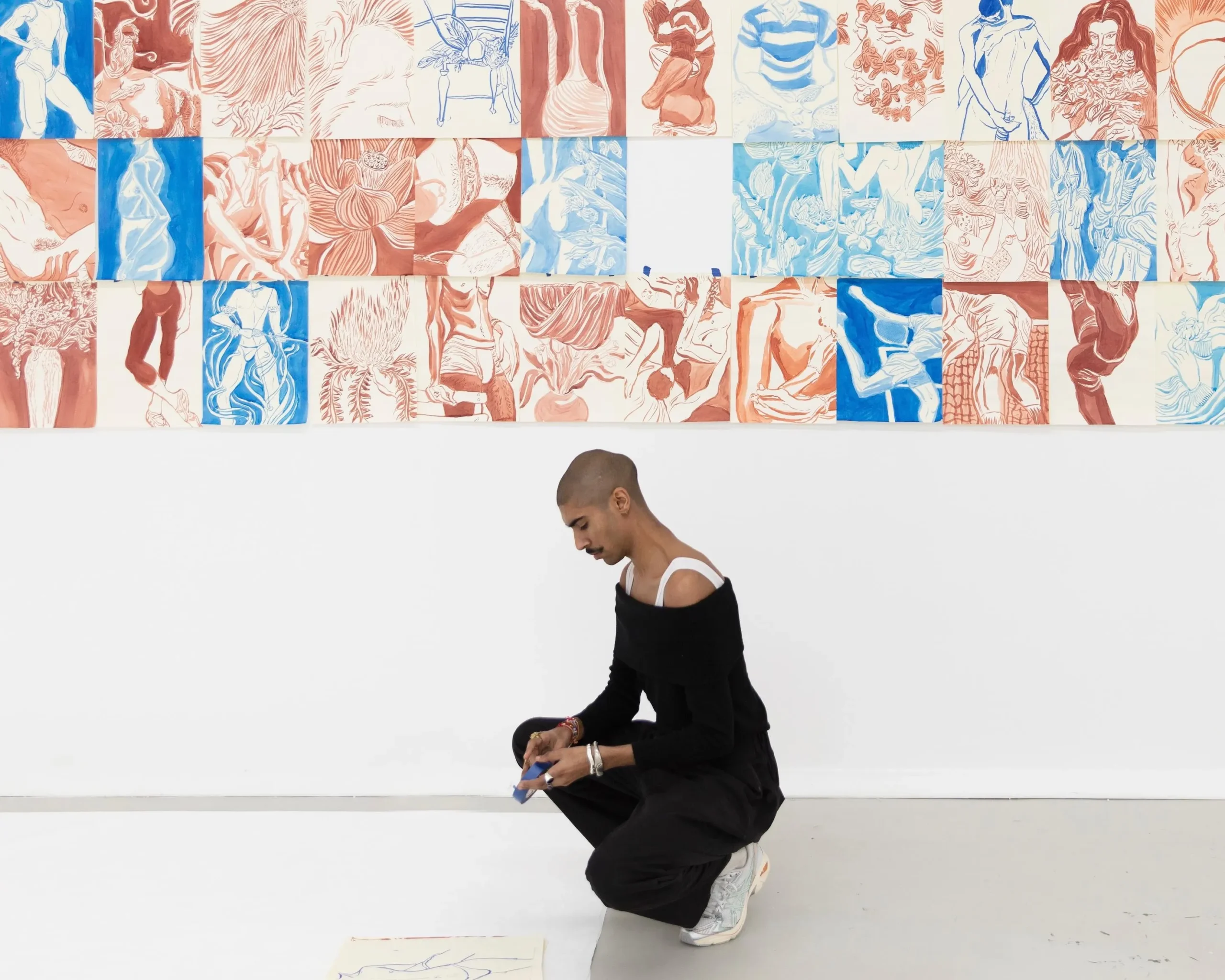
“ephemera of desire”
2025
Ink on paper
Dimensions variable.
Courtesy of Mario Todeschini & Breakroom
Solanki bathes queers figuration in intertwined soft subjects that transparently pass through one another. Each mural announces a particular sociability, where performative gestures demand interaction and deliver intent. As a ballet dancer himself, perhaps we could interpret the mirage of his mediums as the execution of a plié or an arabesque pose. An arabesque is a particular pose in ballet where the body is supported on a single leg, while the other knee is extended directly behind the body. In reflection, Solanki bears the weight of muddied experiences on a single limb, while extending a knee into the soft recognition of the human experience. The plié movement presents the dancer in a bending motion centred around the knee, and perhaps this exhibition is bent towards us in a similar stance, tilting our emotions to swim in this body of water that Solanki has provided. My limited understanding of these poses was jokingly questioned by the artist when I pointed to one of his sketches and asked if it was indeed an example of the arabesque movement.
He laughed and kindly reassured me that it wasn’t, acknowledging my innocent remark. In a particular sense of clarity, each title brings with it poetic stories, soaked in a damp lingo. We brave the texts, stopping halfway to keep our heads above water. Often taking inspiration from his own body or that of the people around him, Solanki provides us with a pool of quick drawings that line the gallery’s wall in the installation titled “ephemera of desire”. A brigade of motifs. When describing the collection of ink drawings, he said that these were made using his left hand and quick attitude. By not utilising his dominant hand, due to a wrist injury, I can see that a light hand bears the weight of shadows within these studies. How many failed drawings fell out of his hand before desire was depicted with an ease that cools the breath whilst you inhale the images?
“Solanki bathes queers figuration in intertwined soft subjects that transparently pass through one another. Each mural announces a particular sociability, where performative gestures demand interaction and deliver intent.”
Shakil Solanki
“whisper a secret into this hollow, and cover it with mud”
2025
Ink on paper
104 x 75 cm
Courtesy of Mario Todeschini & Breakroom
Shakil Solanki
“The Broken Fountain”
2025
Installation Shot
Courtesy of Mario Todeschini & Breakroom
As a consequence, the work is automatically personal in implication and emancipatory in effect. Solanki redirects the argument back to artistic intentionality, promoting queer textures as subjects for an outburst of personification. Titles such as “whisper a secret into this hollow, and cover it with mud” present a consideration of the broader context in which the artist works. We begin to understand that “the broken fountain” claims to defer its context as it actively interrogates its imbrication within its forms. His subjects are self-critical, synthesising themselves, and in doing so, the exhibition entrenches its politics as necessary and competent in relation to the body.
He domesticates a tangible romanticism by quietly radicalising elongated bodies. This frames the appreciation of Solanki’s practice, as we are reminded that one could drown between another’s arms in hues of blue. The exhibition explains to us that thirst can cool the bones if one knows where to drink. But if we drown in salt water, then we float to the shore. The exhibition is this soft landing that we drift towards. I believe that “the broken fountain” is a long-overdue extension of Solanki’s practice that trickles down onto our cheeks and plants a wet kiss on our foreheads.