”
Written byKira Belle
Exposing the Covert Erasure of Women’s Contributions to Humanity.
The moon rose from behind Table Mountain. Its light made a slow descent onto the fynbos, accompanied by the sharp air of the night. I was on one of our family’s annual December holiday camps after passing the 3rd grade in primary school, and before I knew it, my first day on the site had neared its end. The fire pit crackled, beckoning me to rest my eyes – until I heard the adults mention someone that I wasn’t quite familiar with: Winnie Mandela. She was described as “Nelson Mandela’s wife that he cheated on”. What stands out to me now, which didn’t quite click for me then, was how she was spoken of. The phrasing might not seem important, but it highlights an even deeper issue – the sidelining of women in culture and history.
Have you ever noticed the common tendency that people have when talking about a woman? Plenty feel inclined to say “X’s wife“, instead of referring to her by name. In the wake of the recent conversation that has spawned on the internet, due to the newly published docu-series, “The Trials of Winnie Mandela“, I felt as though I should revisit this memory. I have seen some people regard her as a “horrible person”, yet she holds the title “Mother of the Nation”. With all of this in mind, it inspired me to investigate further to deduce if Winnie Mandela’s dismissal by others is justified, or if she was just another woman whose legacy was diminished by a decades-long smear campaign.
Coincidentally, on a quite recent crisp morning, my peruse through a library would gift me something inexplicably valuable: “Empress Dowager Cixi, by Jung Chang”. A book that details the reign of the concubine-to-empress that many today view as controversial. I had run my fingers along the top of the books, and pulled it out by random. Unbeknownst to me, what I would find in this novel would later be relevant to my inspection of the docu-series. Jung Chang’s biography delves into Cixi’s life story, but with one thing missing – sexist bias. Cixi is known as one of the most powerful Chinese women in history, due to her role in modernizing her country and strengthening foreign allies.
Despite this, her legacy has been overshadowed by the notion that she was cruel. The biography familiarized me with her ruling as a whole, instead of just focusing on a portion of her life. In the same regard as Winnie, the notion that she was “cruel”, overshadows her greatest contributions to our country.
It made me think about other historical figures whos’ legacies have suffered the same treatment, such as Joan of Arc, and Lakshmi Bai. It serves as a reminder that the sidelining of women in history is not just an isolated incident, but a systemic issue.
“During Apartheid Winnie Madikizela’s speech was unfiltered, and what many took issue with was how she conducted protests – to put it plainly, ‘peaceful’ was not in her vocabulary.“
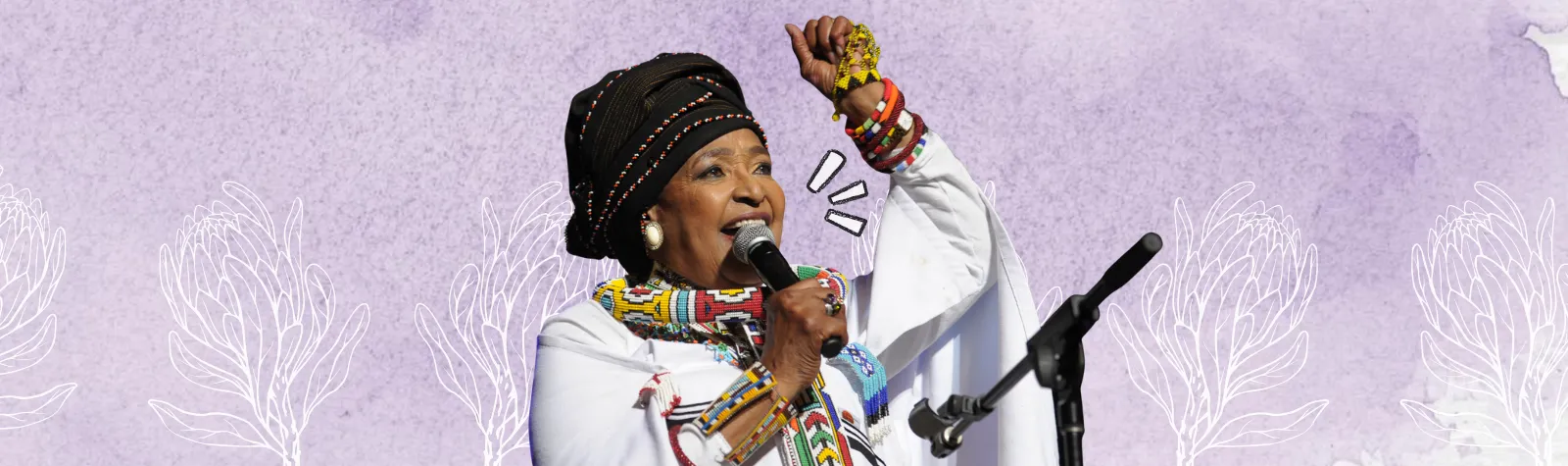
In “The Trials of Winnie Mandela,” the anti-apartheid activist, Winnie Madikizela-Mandela, is interviewed by her granddaughters, Zaziwe and Swati, giving her an opportunity to discuss her difficult past and controversies. Additionally, rare archival footage and other personal accounts make their debut. Some critics feel as though the docu-series justifies her often condemned actions, while others believe it is a touching re-evaluation of her character. Being undermined due to my gender is something I have experienced a plethora of times, and so I’d like to shed light on Winnie’s contributions to South Africa, regarding her not just as a freedom fighter – but as a nuanced person who holds the capacity to be both right and wrong.
During Apartheid Winnie Madikizela’s speech was unfiltered, and what many took issue with was how she conducted protests – to put it plainly, ‘peaceful’ was not in her vocabulary. It is a common sentiment that peaceful protests are the best way to fight for freedom, due to its moral implication, however, to Winnie, it was not the most effective method. In the documentary she mentions a past teacher of hers that referenced a phrase that she would never forget, “The unification of Germany, Bismarck believed, could not be attained by parliamentary speeches, and debates, but by means of blood and iron.”
She continues, explaining that as she got older she realized what he meant; affirming her belief that making change cannot always be attained through non-violent means.
“Confrontation” is a quality that is not commonly encouraged in women. We are expected to be peaceful and passive, though it is extremely evident that Madikizela-Mandela did not inherit those traits when it came to her activism. According to the docu-series, Winnie could become very violent with police officers. When freedom was threatened, the political figure cared not for consequences, but rather for change. Looking upon how women are treated in general, my mind began to wonder. I mulled over the fact that in most communities women are not only made to be the labor-bearers of the family, but are also expected to be grateful for their position in the home. Anger is meant to be concealed, never expressed.
Although western societies have become more progressive over time, it is still marginal in comparison to the various communities that foster misogyny and gender based violence. With everything considered, it is not surprising to me that critics bring up Winnie Mandela’s mistakes, without acknowledging her achievements as a freedom fighter.

Watching the series made more memories from my childhood pop up. I remember watching the women in my community slave behind the kitchen counter, I saw them degrade themselves, I saw them preach “agreeability” rather than courage and yet, when I see Winnie Mandela, I perceive a figure that was stripped of all fear of expectation and stood aside virtues of strength and resolve. Despite this, I do not see her as a perfect idol – rather a regular woman that utilized her fierceness to survive Apartheid and make a difference. Many fell short when they placed such high expectations on her, that they did not extend to the other male political figures. In my community I witnessed men who got away with mistreating their wives and daughters, who then bear all responsibility. My own experiences have shown me the unfair standard that is held above women, that men don’t typically face to the same degree.
Navigating my own identity as an activist, the realization dawned on me that many people do not listen to you when you assume the role of submission or complacency – women are made to think that if they comply with the same system that subjugates them, they can attain free will. It was only when I learnt to be more abrasive with my politics, that I felt myself being taken seriously, not because I was being validated, but because people actually looked when I spoke. This was not new to Winnie Mandela. When a woman has the gall to fight for what she believes in, to be brash, to be a formidable individual, the society that we live in will almost seemingly vow to bring her down.
The docu-series grew even more gripping, as a large point of contention in Madikizela-Mandela’s career was brought up – The United Football Club (UFC), which was created under her wing in 1986, and spear-headed by Wilson Sebiloane. The reasoning behind the UFC’s creation was to create comradery amongst the anti-apartheid activists through a social group. However, as time passed the UFC became known as Winnie’s “body guards”, and it wasn’t soon after, that the unregulated activity of the collective would lead to the assaults of 4 anti-apartheid activists. Stompie Seipei was the name of the 14 year old that had succumbed to the attacks.
I felt myself grow inquisitive, as the details about the ordeal unraveled. It goes that Jerry Richardson murdered Stompie because it was suspected that he was a spy for the anti-apartheid government. The Truth and Reconciliation Committee’s involvement was then also touched upon. Despite Richardson’s confession about murdering Stompie, Winnie Mandela had to take the stand during multiple TRC hearings, having faced multiple charges related to the murder case.
In Winnie’s words she believes that the Apartheid government orchestrated the ordeal to tarnish her reputation. Whether there is truth to that or not, her status as an anti-apartheid activist came second, because many began to view her as a murderer.
Empress Dowager Cixi is seen in the same light, because of the rumour that she killed her nephew, Emperor Guangxu, via poison, after she imprisoned him. The alleged motive being that she didn’t want him to have the power to alter her ruling after her passing, as she too, was coming to her end due to old age. In relation to Winnie Mandela, It has made me think that the worst thing a woman can do, alongside rejecting what is expected of her, is to cross a man, because then she has committed what patriarchal communities consider the ultimate sin – she has rejected her “ruler”, her oppressor. This speaks true to her case, when you consider that the various controversies that undermined her work, were only amplified by her indifference towards ‘peaceful protesting’, meaning she clashed with most of the known male, freedom fighters.
To her, as a woman that was in a state of survival, being peaceful was the last thing on her mind. Similarly, to Dowager Cixi, with the nullified power that women have, she figured that there are only a few ways that women could be heard clearly – and one of them is to fight tooth and nail, without cease.
I found the ‘The Trials of Winnie Mandela,’ to be an informative docu-series, that provided insight into Winnie’s life, while also maintaining a strong narrative which was supported by atmospheric visuals and gorgeous local sound production. The docu-series features both those that are in favour of Winnie, and some that are not. Before diving into the series I saw criticism that it is biased because it’s directed by Winnie Mandela’s granddaughters, however, to me, the inclusion of people that do not agree with Winnie’s politics contradicts that.
Overall, Winnie Mandela is given her flowers in this documentary, as her legacy is conveyed in such an intimate and eloquent way, without ignoring the controversies and various hardships she had to endure. It spoke to me as an activist, that is also a woman, because I felt validated seeing her history being fairly expanded upon. It assures me that despite the ongoing erasure of women’s milestones in our society, there are those that are making an active effort to help change the tide.