”
Written byMatthew Michael
Like a Piece of Mould, People Would Spot Me Easily.
Please, do not forget that some people wear their hearts in other camps, where to be camp is to exist within hostility, where the utility of experience is derived to survive. Often, whilst we chat away the awkward moment between the seating of guests and the start of a play, those on stage meander around, awaiting our pause. On this occasion, the actor on stage seemed to know how such a pause can hover between half-full glasses, and with a thud to the bed, we all shut our mouths, turned towards the stage and placed the wine aside. The manner of his descent suggested the seriousness of the situation and that fine words would butter no parsnips this evening.
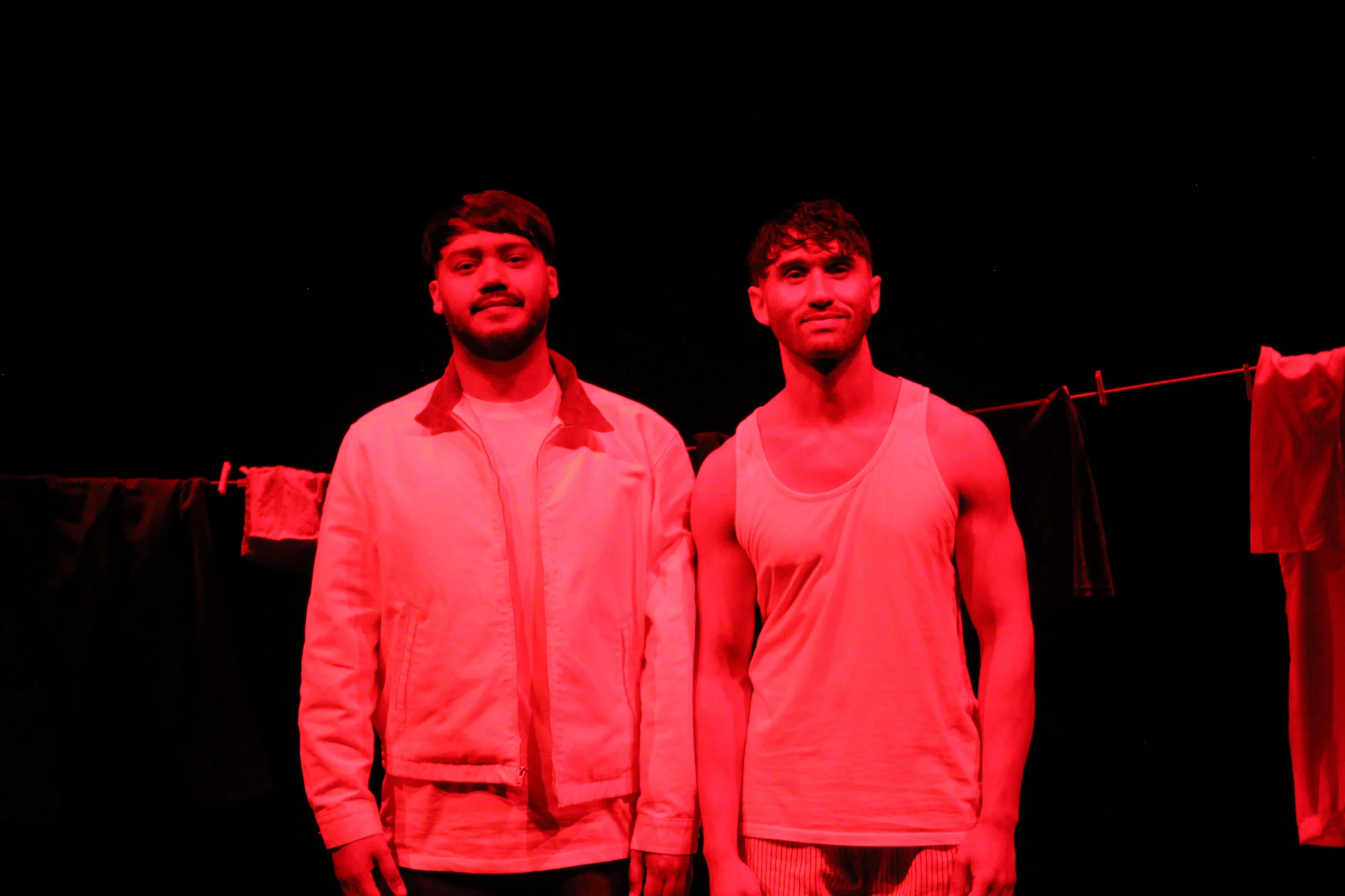
The production, “Please, don’t call me moffie”, written and directed by Zubayr Charles, and housed at Artscape, prompted the audience to relocate their own experiences by witnessing the lives of five different queer coloured men from Cape Town, in their late 20s, who independently encounter a malefic homophobic attack via social media. However, only one man on stage, Anzio September, was designated the brunt of representation as he undressed to shed one life and redressed to allocate the next. The title itself, with its convivial opening word, incites a connu politeness, in which pleading for something deferentially is met with an acknowledgement of derogation at the end of the sentence.
A sort of educational form of benison that happens when one defends their right to exist, as queer bodies often do. The play itself exercised this manner of appeal, where empathy must be mustered up so as not to alienate the capacity to teach. By capitalising the plea and designating lowercase letters for what follows, Charles illustrates how we may catch more bees with honey than with vinegar. Despite the stage design bearing recognisable props such as a bed for sleeping, a table for eating, and other tools depicting lives being lived, it was the washing line that provided clarity of characterisation.
During this one-man show, September would descend to the hanging garments at the back of the stage and return anew. The director’s use of a chore many of us have had to face, that being our laundry, tickled the age-old saying, “Don’t wash your dirty linen in public“. This idiom, a fixed expression bearing metaphorical tidings, describes how private or embarrassing issues (queer visibility within intolerant systems) are not for public consumption. However, it is not the director’s, actor’s, or character’s dirty laundry being strung up, but rather a global linen stained with violence. The episodic structure of the production meant that realism was divided according to each character we bore witness to. Although their commonality was evident, each experience was undeniably unique in September’s ability to counteract who came before.
“However, only one man on stage, Anzio September, was designated the brunt of representation as he undressed to shed one life and redressed to allocate the next.”
As he stripped between characters, what became apparent was whether we hide behind a tablecloth, a screen, a stereotype, or wherever safety might reside. Queer characters inhabiting archetypes prescribed and defined by global judgements can quickly become a tetchy situation. September’s contorted hips and idle wrists, as Zayn, his strict posture as Eesa, to the slump of Mushfeeq’s shoulders all signalled identifiable traits through which we were able to witness their journey. Yet, it is the extremities of these identities that often define how hate may be liked, shared, reposted, or digitally inaugurated in this case. Between the odd songs signalling new characters, we come to understand how safety can be established in the way queerness may be performed, starved, blocked, reported and vaccinated. Through marred videos where queerphobia ripens and rots, such as the one on stage we never see, these characters illustrated how reaction and violation have come to define the manner in which queer bodies learn traits to optimise their preservation. Abdullah, the “Straight Man” archetype, understood that safety can be a privilege defined by the length of your strut or the curve of the wrist, as he states, “Like a piece of unwanted mould, everyone would spot me easily”. His wording, layered with the reality of sexual abuse and tethered to how belittling victims can shroud comprehension, stretched my skin only to fold over into the reality of Abdullah’s childhood and that of many more.
Yet Haroon, stressed and repressed, believed that mould carries a fetid scent, as he cozened himself into believing how one can delay identity in the face of unyielding hatred. Eesa, with muscles masking the musk of his mould, described a “delayed moffie”, hinting at how identity can be halted by hatred but never extinguished. Zayn, our declared diva on stage, resisted inherited social and cultural expectations with a feisty attitude as Britney Spears announced his arrival and signalled towards each character’s generation. What we see as purposeful and blatant stereotypes within some of the characters – those repeated behaviours or acts that often bleed into who we are – become beacons for those who wish to maraud authenticity whilst punitive punishment parades cyberspace. Sterile videos, shared telephonically, emphasise how digital spheres can instantaneously breed a space for hate, where jovial audiences nibble on the pain of others and snicker at online safety guidelines. This play was not idle in its representation but instead charged with examining the costs of social practices that produce both camouflaged and socially declared agents. We had no remission from the subject matter being dressed before us. Instead, we clung to our empty glasses as the individuals before us clutched their realities.
Zubayr Charles‘s dramaturgical language does not legitimise hegemonic normalisations within queer representation and theatre; instead, it quietly optimises language as a means of providing context. The online catalyst for this story remains visually elusive to us who are but witnesses; however, those behind it exclaim, “Al Lutiyah Muharama fie al Islam”. When one hears hate, whether we speak the language or not, it is a recognisable utterance where syllables give way to intent. The director provided both their intent and translation in saying that “to be a deviant [gay] is forbidden in Islam.” The etymology of “deviants”, denoting those who are dangerously abnormal to the norm, alongside contemporary semantic fields, acts as a prodrome for socio-cultural intolerance; language optimises oppression before one’s wrists hit a 90-degree angle. Within Arab culture and language, terms referencing queer bodies historically existed as monuments enforcing malice. As stated earlier, Abdullah and Eesa’s fearful descriptions of queer detection come to extract the Arabic use of language as a fear-enforcing tool, where their honest words colloquially incite tangible experiences juxtaposed against a linguistic system built, in this instance, for intolerance. When Eesa turned to the crowd, with his belated queer reality toppling down on him, his phrasing drew us into a world where berated bodies battle for acceptance.
Reflecting on Kamogelo Molobye’s words in Storying Silenced Queer Narratives: Koleka Putuma’s re-membering and re-memorying of Queer Trauma in No Easter Sunday for Queers, where he incites queer performance as a process of retention and release whereby normalisation confronts the significance surrounding themes of survival and our capacity to thrive as queer bodies [Molobye, 2023]. This story seemed to grapple with Molobye’s geo-cultural contexts as a site for navigating religious anti-queer violence, as within Charles’ writing outlying narratives are not strung up on a washing line to be bleached by the sun. But rather inhabited within the centre, resisting erasure [Molobye, 2023]. Although the characters within “Please, don’t call me moffie” do not haunt the present, as Molobye suggests in relation to Koleka Putuma’s No Easter Sunday for Queers, but are instead haunted by the existential threat of existence inscribed by queerphobia, enforced by cultural expectations and automated through social media.
“Sterile videos, shared telephonically, emphasise how digital spheres can instantaneously breed a space for hate, where jovial audiences nibble on the pain of others and snicker at online safety guidelines.
In this way, Charles beckons the present through its instantaneous digital outlets whilst designating a space for the realities surrounding LGBTQIA+ issues within the Global South today. To tackle these themes, Charles and September had to locate the self; I am not referencing their personal experiences, as I cannot speak for either of them, but rather how communities share their wounds as a means to critique how the centre may be processed through self-voicing [Molobye, 2023]. As a somewhat autoethnographic production, September was able to perform the “situatedness of self with others in social contexts” through the director’s perspective [Spyr, 2001]. Although it was not his life on stage but instead a grouping of collective experiences, both the director and actor upheld a loosely autobiographical narrative as they spoke from within their community. This allowed the audience to peep into the intersecting ways personal narratives in performance situate the socio-politically inscribed body as a central site for meaning-making [Molobye, 2023]. I want to return to Abdullah’s story and the moment when he thrusts his demonstration of molestation upon a table. Those of us who witnessed this recounting became involuntarily embedded within a transgressive act.
In Charles’s use of imagery and September’s deliverance of it, we as the audience become soberingly aware of social transgression within immediate contexts. Our consumption of such a deed necessitated a revision of how contact and conquest are inextricably conjoined within family systems. Where seedy sins often gawk at comprehension when the truth finds its footing. By tackling such intimate themes, the director and actor highlight the complexity of discrimination within systemic power systems, whether familiar or otherwise, by locating the self to produce a modern paradigm where clickbait baits us all. Within the span of 60 minutes, this play navigates how caste-like hierarchies cannot be hung out to dry, but similar to how laundry cannot be avoided, we must interject. Even if we are indeed the only one on stage facing a clothing rack, mouldy in its conviction.
The characters depicted within “Please, don’t call me moffie” are differentiated by their archetypes, yet we realise how the garments and personalities identifying them carry different residues of queer experience. Mushfeeq notes the tragedy in queer alienation, yet as a journalist, his ability to counter remains idly present. Abdullah’s overweening confidence carries hidden splotches too tough to scrub out; Eesa attempts to tame steel, but struggle can be heard over muscles bearing mountains; Zayn’s quick-witted sass suggests that courage must be built in accordance with how who we are becomes undeniably apparent, and Haroon cannot find himself when other men have found god’s words in their hands.
Despite the mouth-puckering actions performed on stage that linger below the tongue, the play…
LONGLINE: After viewing a viral online video of a brutal homophobic attack in an unknown country, five Coloured gay men in their late 20s react and share their experiences growing up queer and grappling with identity in Cape Town, South Africa.
TERMS: Although the play depicts the brutal aftereffects of homophobia, as society moves forward and language evolves, several non-derogatory terms have entered the Arabic vocabulary. It is important to note that many Arabic speakers may not recognise these words, as these are often neologisms created by queer individuals who want to use their dialect of Arabic to articulate identity more affirmatively. Although Charles does not incorporate these terms into the play, since the play is set in Cape Town and the characters speak English as their mother tongue, it is still useful to acknowledge that the following terminology does exist: misliya (مثلية) — lesbian; misli (مثلي) — gay; mozdawij (مزودج) — bisexual; moghayir (مغير) — trans; “Ahrar el jins” (أحرار الجنس) or sad (شاذ)– queer .
All can be referenced here.