”
Written byLudwig Spies
Fuck The Algorithm, Darling: A candid interview with Kevin Kat and Tiaan Silly, creators of the unapologetic and uncensored queer art cult, Darling Boys.
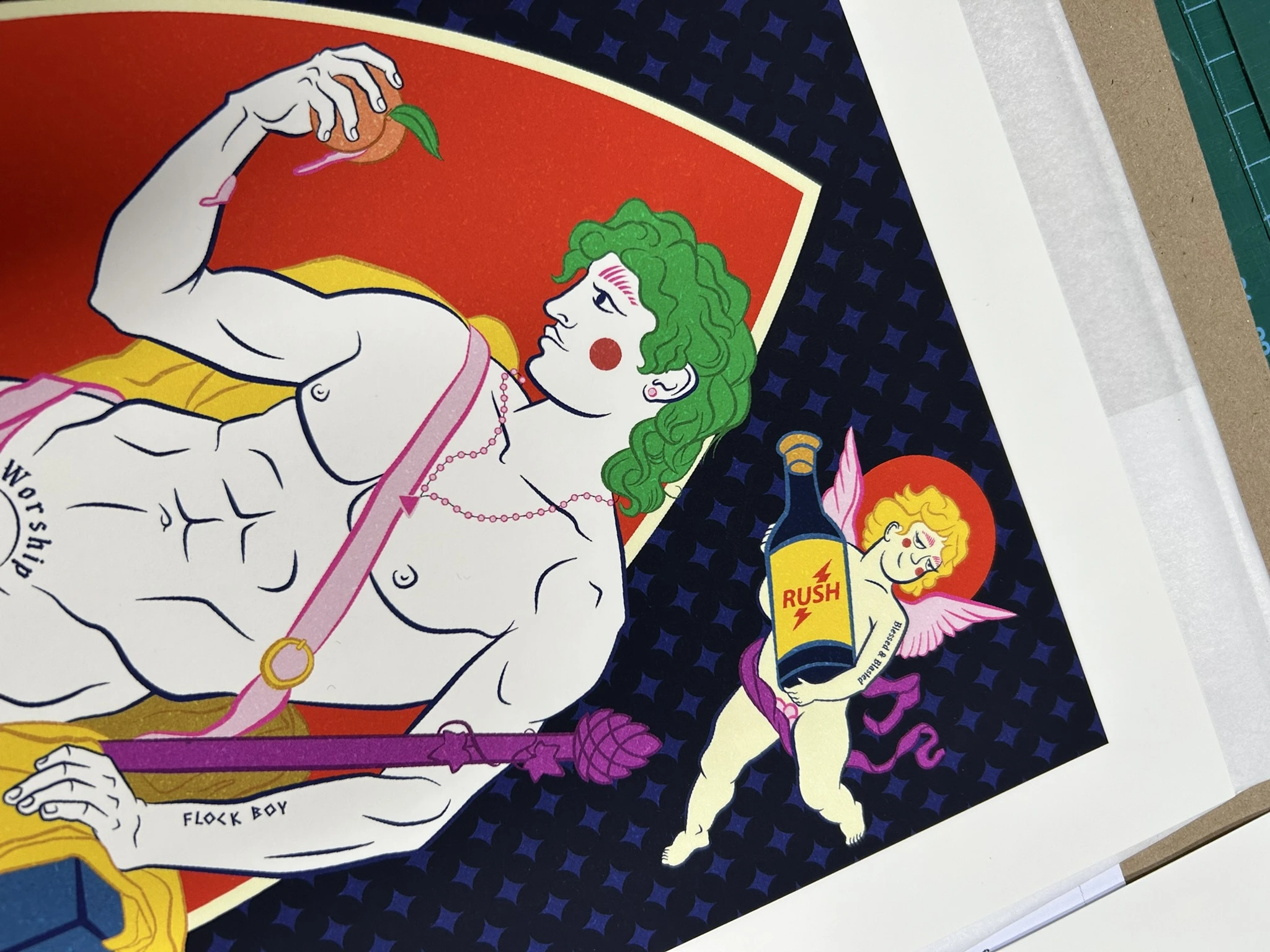
Darling Boys is a bold celebration of queer expression — sexy, funny and a little dangerous. From fine art prints to filthy little stickers, they turn queer joy into something you can hang, wear, gift or slap on a mirror. In this interview, co-creators Kevin (@kevinkat) and Tiaan (@tiaansilly) talk about the gay experience, queer Pride, sex, community and how they turned a creative passion into a business.
For Kevin, creativity has always been central to how he navigates the world. He studied art in high school but was cautioned against enrolling for an art degree. Instead, he chose to study literature, hoping this would provide him with a broader exposure and understanding that would eventually inform his artistic practice. After university he worked in several creative roles, including a stint as layout editor and writer at Gay Pages Magazine. The position immersed him in queer culture and connected him with other gay creatives, artists and writers.
Through that experience he began to fall in love with graphic design and developed an interest in a particular strand of queer art that was both visually striking and unapologetically erotic.
Harnessing the creative work into a business project required another skill set, gaily offered by Kevin’s close friend, Tiaan la Grange. Tiaan’s background in television, film and events, along with his current work in marketing, complemented Kevin’s artistic focus. When Tiaan first saw the illustrations, he immediately recognised their potential.
“When I saw Kevin’s work I thought, this is amazing. We need to do something with this”, Tiaan recalls. “I love creative chaos, and this was very much that. It was very exciting and I jumped right in.” Today, the two divide their roles clearly. Kevin focuses primarily on the art itself, while Tiaan concentrates on expanding the brand and building its audience.
“When Tiaan first saw the illustrations, he immediately recognised their potential.“
Ludwig: Please tell us about your creative background and how Darling Boys was born.
Kevin: I’ve always been a creative child. I studied literature to learn more about the world in the hope that it would influence or direct my art in some way. Later, I worked for Gay Pages Magazine and that really brought me into the gay world, and into contact with a lot of gay creatives, artwork and people in general. I fell in love with graphic design, which eventually became my career, and found a lot of inspiration in super gay art. The kind of stuff that’s both creative and explicit, and turns you on. Works by artists like Mel Odom, for example.
That’s where my interest in this kind of artwork really started. I also have this crazy love for stickers, so I began making these gay stickers that could be plastered all over in public spaces. Then I thought these could actually be really cool artworks. I needed a partner to get to a point where it could be a business and the artwork could go further. Tiaan is my best friend and he was the best person for the job.
Tiaan: I come from the TV, film and events world and currently work in marketing. That perfectly aligned with what Kevin needed to bring the business to life.
When I saw Kevin’s work I thought this is amazing, we need to do something with this. I love creative chaos, and this was very much that. It was very exciting and I jumped right in. Kevin is mostly the art guy, and I focus on the rest — how to make it bigger and louder. The goal is to make Darling Boys an art cult that’s loud and proud.
Ludwig: Tell us about the process and experience of turning a creative passion project into a creative business.
Tiaan: Us being close friends was a concern. It takes time to figure out how to work with each other, how to work together as one very creative person and one very structured person. At first you do bump heads, and you have to navigate clashes, but it becomes easier and more collaborative.
Kevin: It’s the first time that either of us have attempted to establish a business, so it’s a major learning curve. Just setting up the online shop was a lot of work. Not to mention the thousand things that happen offline. Figuring out how much your art is worth is a big thing. Sometimes I think we charge too much, and then not enough. Most other artists say we’re not charging enough, but I really want it to be accessible to as many people as possible.

Ludwig: Establishing a commercially viable art business is challenging, and probably more so in South Africa and especially when it’s queer art that might only appeal to a smaller market. How do you meet these challenges?
Kevin: We want to make artwork for other people like us who are loud and proud and exist in these vibrant queer pockets like Cape Town and Joburg. I really want it to speak to our gay life, experience and culture. But if you’re not going to buy the art right now, I still want you to fall in love with the images and the stories behind them, and the brand ethos. I still want you to join this movement, maybe through something more affordable, like our speedos, crop tops and Pride paraphernalia. Our wearable art. I want people to live in and enjoy the brand so much that they eventually feel they want this as a piece for their house.
Tiaan: But reaching the audience and market on our social media platforms is challenging. Apart from it being a smaller group, we can’t use direct targeting tools to reach queer users and communities. We have to find other ways of tapping into queer networks and reaching the people who would identify with our brand and lifestyle. Collaborations have helped us greatly to increase our reach. Apart from the marketing benefits, we love linking up with other proudly queer brands and connecting with audiences collectively to bring them enjoyment, whether in the form of entertainment, fashion or art.
Kevin: We face a greater struggle because our work has an erotic quality, and a queer erotic quality at that. We get shadow banned very quickly. It’s very hard to promote your work when it’s constantly being pushed down by the algorithm. So our first crop-top in the Bulge & Bum range has ‘Fuck The Algorithm’ printed on the front. We will find ways to get the artwork to the people that enjoy it.
Ludwig: In that context, I think your work acquires a protest element merely by existing on these platforms and from your commitment to continue publishing and promoting. Talk to us more about visibility, Pride and resistance.
Kevin: It seems that anything sensual involving two males is this taboo thing. Something that you need to shield children from, or whatever. I really think it’s ridiculous. Nudity is part of life, sex is part of life. Maybe straight brands that are doing something similar are having the same struggles, but there is a sense that it is harder because we’re a queer brand. I just want the work to go places, for people to see it and for it to make a positive impact. Maybe it can help someone recognise their queerness and come to terms with their sexuality. I always think about this; the queer awakening, the first time you knew. So often it’s catalysed by an image in popular media or art, and I want this work to be able to do that for someone.
Ludwig: What about your choice to go all the way back to Antiquity in search of figures and stories? It’s interesting that this imagery holds this enduring gay appeal and widespread resonance.
Kevin: There are a couple of answers to that question. Drawing from Antiquity shows that same-sex attraction and queerness, even if labelled differently then, has always been there. It’s not a recent cultural fad or phase, something that was suddenly invented. In Africa, we often hear that it is ‘un-African’ to be gay, that it’s a colonial import. This is also clearly untrue in the face of evidence that queerness has always been here too. The other part is that I love history and literature, and I find a lot of inspiration from myths and legends. I’m a fantasy lover and always have been. One of my early mentors was the artist Yannis Generalis. I learnt a lot about Greek culture and mythology through his work.
Tiaan: I’m not so big on literature, but as a gay person, I can see the gay in mythology. The gods have always been messy and horny, and vengeful and beautiful. As a queer person, I see a lot of ourselves in those stories. It’s always this forbidden desire and tragic love. I think a little bit of that lives in all of us and so we gravitate towards that. It’s why I was immediately attracted to the work Kevin was doing.
Ludwig: You’ve also reinterpreted these Classical characters and images with contemporary elements that make total sense and give further credence to the timeless relevance of the characters and themes. How do you go about this process of updating?
Kevin: A lot of inspiration for the work comes from scrolling social media, following people that I find interesting or attractive. In part, there’s this Classical inspiration for the works but then a lot of it comes from seeing how we use social media to portray ourselves in a sexual way. Gay men are very sexual on social media. We purposefully craft a picture for desirability. We easily post pictures of our naked bums, and it’s just normal. I love that. I think it’s so free and open, and quite thrilling. So I’ve just kind of mashed together Classical and social media imagery and influences to tell these stories.
Tiaan: I think South Africans generally have a great capacity for reinvention. We’ve gone through a lot of transformation and evolution. And queer people even more so. We inherit traditions and then remix them for survival. I think Darling Boys is an example of that. We tried to create a new way of clearly, proudly and comfortably expressing who you are when you go to Clifton Beach (wearing a Darling Boys piece), or when your family comes to visit (and our art is hanging on your wall). We want to be part of a cultural shift towards greater visibility and authenticity.
Ludwig: Tiaan used the descriptions ‘messy’ and ‘magical’ together earlier; it’s a mood that shines through in the About section of your website too, which contains references to sex (and specifically the type of sex that may be frowned upon); cruising, bathroom stalls, poppers… On the one hand I want to say that we are very out, open and unashamed. On the other hand, I feel we are still very much in the closet about what we like, what we do, who we do it with and where we do it. We even see this between queer people as hetero-normative or other forms of assimilationism creates divides between different groups.
Kevin: I constantly find myself censoring myself. When my boyfriend tells his straight friends that I sell gay art and he goes ‘show them, show them’, I immediately start apologising before I show them anything. I say ‘oh, it’s very gay’ and I give them all these ‘warnings’ before I show them. In many ways we are still afraid, and maybe a little ashamed of ourselves. So I think making the artwork and publicising it is also a process for me to embrace myself and to stop making excuses for myself, the way that I live, and the things that I am attracted to. A big part of it is also the playfulness of it. Gay men are often still in their discovery years in their 20s and 30s. We’re exploring things now that straight kids would have done in high school whereas we were in the closet. We often only get to do the fun, silly and wild parts of life later; in their 40s or 50s for some people. I think our work touches on that and sketches a picture of how we live because of those circumstances.
Ludwig: Tell us about your collaborations. What attracted you to co-create with these partners?
Kevin: We looked at who’s prominent on the scene right now, and Tollie came up as somebody that has a great following, has a very strong voice and is so unapologetically herself. I studied what she was doing on social media, the way she speaks and the way she embodies her character. With us all being Afrikaans, we share a certain cultural context and sense of humour that allow us to make fun of things in a particular way. I think she is an inspiration to a lot of people and we loved working with her.
Tiaan: With Tollie I was nervous at first, because Kevin made her look very sexy, but she dresses a little bit like a Tannie. But Kevin said no, that is not my art, that is not how I do things. And then he drew inspiration from all these South African elements, brought this piece together, and Tollie was in love with it. She bought an A0 print of this piece. I love Tollie’s content and it was great to connect and partner with someone in our community. It was a very special collab and a lot of fun.
Kevin: The collaboration with Bulge & Bum is part of our wearable art. We put our work on speedos and underwear, two very prominent symbols in gay culture. I know every gay person isn’t into that, but we are and we want to cater to people like us. And our art translates very well onto those items. We started with three swimwear pieces and matching towels, three briefs, and a box cropped top printed with a mix of artworks. It’s a very affordable way to own the art and it frees it from the wall to traverse the city and be seen. And then we did a very special artistic collaboration with my friend, photographer Laura Iikannen. We share a love for the male form. We produced a series of six works about seduction titled Siren Songs. Tiaan and I are very excited about what the new year holds, doing more collaborations, building our community and reaching more people with our art.