
”
Written byShaheena Links
The Past Casts Long Shadows
Before the start of the play, the atmosphere is already built. You are greeted by the smell of the miyang stokkies (incense sticks) and the sounds of thikrullah (remembrance of God through recitation) in the background. There are old family photos along the walls and Islamic art by Ni-shaat Bardien, and for a split second, it felt as if I was back in my granny’s home.
A man sits on the stage with the haunted expression of someone who has lost half his world. What follows next is a monologue that touches on the fears that many muslims hold: what happens when we die? What happens when our bodies are on the kaatel (bier)? What happens when the toekamanie (people who wash the deceased) performs the final ghusl (cleansing ritual)? What will happen to his soul in the Barzakh (waiting period after death)? As Luqmaan is sitting in his living room, we, as the audience, wonder: was he a good man, good father, a good husband, and a good Muslim? When he dies, and his deeds are measured, will he come up short?
Written by Zubayr Charles and directed by Carlo Daniels, ‘Brasse, Tot Laat Toe’, is a play that blends magical realism with physical theatre to explore grief, friendship and the unresolved wounds of the past. Luqmaan is sitting in his living room after his deceased wife’s forty-night memorial service when an unexpected visitor arrives at his door: his old friend Junaid. They have not seen each other in over six years. The visit is not a pleasant one,
as it brings up many uncomfortable truths about their friendship and life. The play jumps between the past and present day to show how their friendship blossomed and what led to the eventual breakdown. The scene transition were expertly done by changing to blue lights for the childhood memories. Franky Steyn was responsible for the lighting design, the 2025 Fleur Du Cap Theatre Award winner for Best Lighting. This made it easier to follow the time jumps, and never left space for confusion. Luqmaan is portrayed by Abdullatief Daniels, and Junaid is portrayed by Anzio September.
Two young men from vastly different backgrounds and upbringings, are stuck together in Saturday detention, and are forced to speak to one another to pass the time. Despite their differences, they start to bond and spend more time together outside of school. Thereafter; we reach a pivotal scene where we discover that Junaid felt betrayed by something Luqmaan did. I am sure I felt and heard a collective audience gasp.
Abdullatief Daniels and Anzio September’s acting performances are both raw and vulnerable. Their emotions feel as if they are right on the surface of their skin. They don’t hold back on their sadness and vitriol. You feel their pain. It’s relatable for anyone who has experienced the pain of losing a friendship. At the height of their conflict, you can feel that they are still trying to fight their way back to each other.
“Director Carlo Daniels effectively utilized movement, lighting, sound and costume to create shifts between past and present, the transitions did not need to be explicitly stated.”
When Junaid explains why he felt betrayed, you experience the betrayal alongside him. Your heart breaks with him too. It is only then that the weight of Junaid’s actions sinks in and he realizes the impact of what he did. Here are two men in their thirties trying to reconcile decades of grief, unresolved trauma, and family conflict without ‘new age therapy speak’ – simply showing up as their authentic, messy selves.
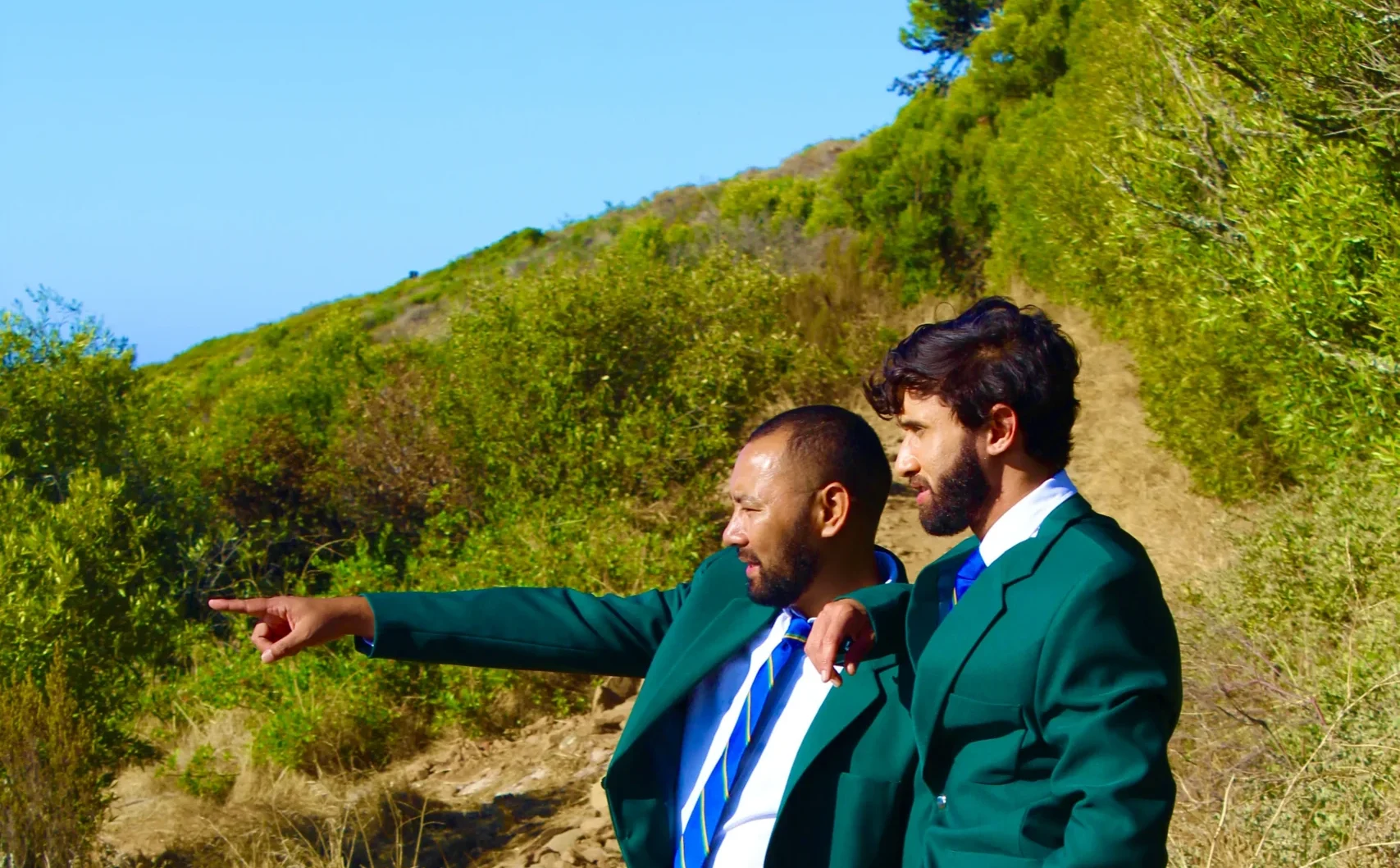
We do get joyful reprieves when Junaid dons the green blazer, which also indicates a transition to the past. The play does not have to rely on many props to do this; one blazer is sufficient. Perhaps Luqmaan does not have a blazer because he comes from a poorer background? Or is this how Luqmaan wants to remember Junaid, as the young boy full of life and energy? We are not sure if this is merely a peek into the past or Luqmaan’s memories. They embody the youthful spirit of the teenage boy, playing tok-tokkie (ding-dong ditch) in detention, keeping a lookout for the principal, talking about movies, and sharing their lunch. Their friendship develops from passing acquaintances to something much deeper, all before being almost irrevocably fractured. The magical realism of the play allows it to blur the lines between what’s real and what’s not. Theatre allows for magic and absurdity to be blended seamlessly and gives the audience the space to interpret it how they want to.
Director Carlo Daniels effectively utilised movement, lighting, sound and costume to create shifts between past and present, the transitions did not need to be explicitly stated. The repeated gestures, movement, and knocking could be interpreted as repeating old toxic behaviours. The bodily checking, lighting changes, and ghost-like atmosphere are like our past refusing not to haunt us.
These symbols feel organic, and the character’s emotional states enhance the themes already present. The director puts a lot of trust in his audience, and I, too, trusted the process and felt myself swept up in the production. There were also times when the physical movements were beautiful at communicating fear and pain. At certain points, especially during Luqmaan’s monologues – which were powerful – I found Junaid’s choreography distracting.
Ultimately, the production’s strongest emotional anchor remains the complicated history between Luqmaan and Junaid. The friendship between them was convincingly portrayed. Years of underlying emotions were peeled back layer by layer; each reveal was more heartbreaking than the previous one. There were moments when it felt like they were two spirits passing by each other in a big empty house, lost and trying to find one another. Many revealed after the show that they interpreted Junaid’s character as a literal ghost, but I did not interpret Junaid as such. I don’t think it’s a problem if audience members take liberties and see Junaid as a ghost or a memory – that’s the beauty of art, we get to infer and create meaning as we see fit. I also took my partner along, who is not Muslim, so I had to check in with him to ensure that he was following along as the dialogue was a heavy blend of Kaaps, Arabic expressions, and Cape Muslim vernacular. I can see how Charles’ use of language might not be familiar for other audience members.
I, however, was in ‘vernac’ heaven. The language of the dialogue felt like a homecoming. I chuckled, laughed out loud, and teared up at all the appropriate moments. This could so easily have been my family. I grew up in Bo-Kaap, and the script reflected people who felt unmistakably like my people.
I am glad the language was not softened or translated for a mainstream audience. The writer, Zubayr Charles, is inviting the audience to glimpse into a world they might not ordinarily have access to. I have been to many poetry performances where poets performed in isiXhosa, isiZulu and other indigenous languages in performance without understanding every word, but it did not make the performance any less powerful. I was still moved by the tone and emotion.
Therefore, it matters that writer Charles chooses this linguistic register for this particular play. This is his heritage, and he is paying homage. Representation like this matters, and it has to start somewhere. One voice gives courage to the next. It is clear that Charles wanted to depict the language of our community, and it felt good to be seen. Our stories were always told orally, passed down from one generation to the next. Theatre is a way for our language to be performed and preserved. This may just be one story told, but it’s also a narrative experienced by many families. It felt all too familiar, and seeing it performed on stage at The Baxter Theatre was monumental. Due to our country’s difficult history, for the longest time, stories like this were not allowed on mainstream stages, but things are starting to change, and our voices are moving from the margins to center stage where they belong. That’s not to say that there is only pain.
Humour, love and cultural references were brought to life. A slice of life, more than just the violence we are used to seeing portrayed in productions such as Kinnes Vannie Ses and other hyper-local Cape stories. Apart from the language in this story, it has more mass appeal as it deals with universal themes — experiences that extend far beyond one community. We should not have to dilute our stories in order for them to be more palatable for a broader audience.
By showing the full breadth of our community – in full colour – we are inviting them in, asking them to take a seat, have a cup of tea and a hertzoggie or koesister with us. Audiences do not need to know every word in ‘Brasse, Tot Laat Toe’; there is enough material for them to understand themes of the story.
What the audience may not always grasp linguistically, the production communicates visually and emotionally. The Islamic artwork in the Masambe foyer, alongside the doilies, decorative elements and a small section of checked linoleum, evokes a feeling of a Muslim home. It felt like stepping into a time capsule, all while remaining deliberately incomplete. Daniels’ minimalist set design adds a sense of bereftness.
The stage is empty apart from the frames, a tiny table, a chair, and a cup. The barren frames on stage depict loss. They cast shadows across the stage, letting the audience know of the lasting impact people have on our lives long after they have left or passed on – it all adds to Luqmaan’s emotional state, his current sense of loss that he is dealing with. The cup that he sips on throughout the play is empty. It remains a recurring motif – the presence of someone long after they are gone.
Daniel’s wants us to experience this emptiness with Luqmaan. Junaid moves freely, eventually leaving Luqmaan alone in the space. When Junaid reveals his true reason for returning, only then do the two men unpack their grief and unresolved childhood traumas; only then do they give each other space to breathe. They find a way back to each other by letting go of long-held resentments and betrayals and too many years of things left unsaid. Time and distance may have faded the bond, but it never severed it.
Finally, the original music by Salie Charles, Charles’s father, sounded like everything I grew up listening to. Nostalgic. Soothing. Aching. I also think it’s extremely significant for a father and son to collaborate on a work concerned with family, memory, grief, and inheritance.
Sadly, in our Cape Cultured and Cape Malay community, where many family structures are fractured, it is beautiful that father and son can work together on a project and bring it to life in a theatre that is almost fifty years old. Cape Malay choir has a rich cultural history and is linked to artistic expression and storytelling passed from one generation to the next, so this feels like a passing of the baton from father to son. The score links the play even closer to Cape Muslim identity, heritage and cultural memory. It is clear that both Charles and Daniels have a deep respect for what has come before and have infused it into his play. He has inherited what his father has passed on from the previous generation, and this is a real intergenerational artistic relationship.
There are scenes of much-needed levity to break up the heavier and more emotionally tense moments.
Reminiscing and nostalgia are powerful, but all too soon anger takes root and insults are hurled across the room, more razor-sharp than a scalpel, the way only loved ones know how to do. Both actors throw their entire bodies into the play, not only with their brilliant acting performances but with the choreography interspersed throughout the play. They react to each line delivered viscerally.
Finally, at the end of the play, I walked away with tears in my eyes. ‘Brasse, Tot Laat Toe’, was not only an emotional experience, but it perfectly encapsulates that underneath all the trauma, grief, resentment and anger, two friends can find their way back to resolution, love and peace. This play is about family, friendship and masculinity – toxic and healthy ends of the spectrum. At the end of the play, Luqmaan has made peace with the ghosts of the past. His closing monologue echoes his opening one. He still does not know what awaits him on the other side when his time comes, but he vows to be a better father, a better man, a better muslim, and a better friend. The lesson here is that we don’t only inherit memories and stories, but also wounds, and it is our duty to heal those if we don’t want to pass those along to the next generation.