”
Written byZubayr Charles
Disabled, But… She Is Fierce, Honest and Writes the Body’s Truth
Interview by Zubayr Charles
In a world plagued with instant gratification and social media, Kirsten Deane tells her truth through poetry.
uHlanga Press proudly presents “Disabled, But.” a poetry collection by Kirsten Deane.
The collection, which will be released this April, has been described as “finely poised and subtly subversive”, as it reveals Deane’s experiences with self-love and internalised hatred. As readers, we follow Deane’s journey as a young woman making sense of her disability; a woman who wants to shrink even as she grows — someone learning to live with pain and discomfort as constant companions, even as trusted friends.
The collection does not shy away from body horror, as Deane writes about her experiences with disability from a place not simply close to the bone, but from the very marrow. Both accessible and estranging, “Disabled, But.” is evidence of a powerful and essential new voice, particularly as it provides representation for the underrepresented in South African literature.
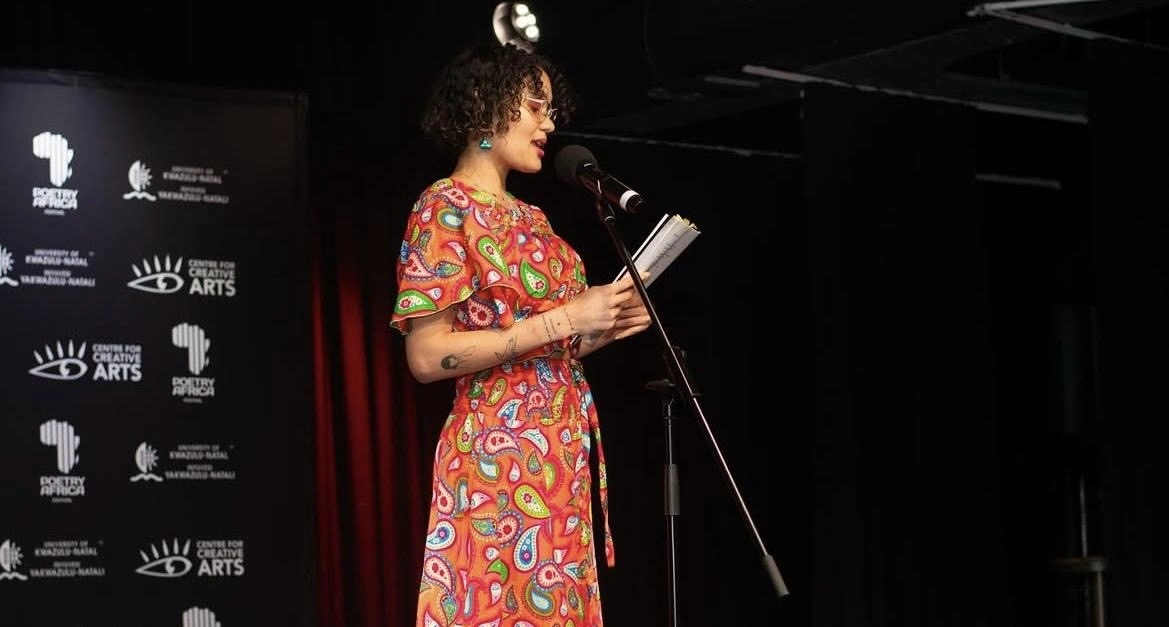
Resident writer Zubayr Charles chats to Kirsten Deane about her upcoming poetry collection.
“The collection does not shy away from body horror, as Deane writes about her experiences with disability from a place not simply close to the bone, but from the very marrow.”
Zubayr: Kirsten, firstly, congratulations on your debut collection. Can you briefly describe how are you feeling about the upcoming release? It’s not easy to get a poetry collection published in South Africa, so well done, once again!
Kirsten: I don’t think it’s really settled in for me just yet. I have moments of disbelief that it’s actually happening. Those moments are then followed by crippling anxiety and fear, but not the kind of anxiety and fear that you want to go away. I’m okay with these feelings. They remind me that this shouldn’t be treated lightly. I’m relieved and happy for my younger self, even myself from yesterday. Every word in this collection belongs to her.
Z: Although this is your debut collection, you have already established a name for yourself in Cape Town’s poetry scene. Why has it taken this long for the collection to be published?
K: I am and always was just completely and utterly consumed by the simple act of writing. What matters most to me is being able to sit on my bed (normally after a shower) with my notebook and pen, and just see what comes out of me. My biggest fear was always waking up one day and not being able to write, so I always focused on the core of my relationship with writing. Don’t get me wrong, I thought about publishing many, many times, but I’m a firm believer in not getting consumed with the idea of publishing, but rather the dream of being able to write every day, in any moment, about absolutely anything. So I took my time with the collection, even after I signed the contract, I didn’t feel the need to rush anything. I wanted the poems to be published when I was ready to let them live on their own.
When we stop doing something just for the love of it and start doing it so that we can tell people we do, we are in a lot of trouble as creatives. Creativity requires humility, and for me, that means always staying focused on writing, not publishing.

Z: Let’s talk about the title. What does “Disabled, But.” mean to you?
K: I’m sure that I’ll get asked this question a lot once the book is out. And I’m glad, it’s intentional. I was born with left hemiplegia, scoliosis, and epilepsy. Growing up, my family never sugar-coated that I have a disability/ties, and the outside world definitely didn’t sugar-coat it either.
When people think of disabilities, they often have a specific image in their minds – somebody in a wheelchair is the most common assumption. My journey to writing about, understanding, and (sometimes) accepting my disability has not been linear or easy. I was pushed and encouraged to write about it by my supervisor and mentor, Kobus Moolman. After I started writing about it, I discovered that I have a consuming passion for bringing awareness around disabilities – that they don’t all look the same… sometimes, more often than not, you don’t see them at all.
Long story short, to me, “Disabled, But.” means my body is real, it is true, it is very much in existence with my disability as a big part of it, even when the world refuses to acknowledge or accept it.
Z: How would you describe, in simple terms, what this collection is about?
K: I have been asked this question so many times, and I still don’t know how to answer it! It’s about everything that the body experiences. Not just physically, but psychologically, genetically, through thoughts, through longing, through hatred… and yes, through joy. It’s about the way in which discomfort makes us present and mindful in our existence.
Z: At first glance, the cover struck me as an interesting choice. Whilst beautiful, it also seemed layered with subtle symbolism the longer I looked at it. Could you tell us about the process of choosing the cover?
K: My process of choosing the cover was as impulsive and simple as my writing process. When Nick Mulgrew (uHlanga founder and editor) asked me to start thinking about the cover, I had absolutely nothing in mind. I was blank. He told me to have a look at other books and see what stood out to me, but nothing felt right for this collection.
I have an obsession with insects and parts of the body that hold a lot of horror – basically, parts of the body that people don’t really pay much attention to. While I was completing the collection, I thought a lot about teeth… their fragility, what they’re made of, how they are capable of rotting, dying, and leaving us with an empty mouth. Once the collection was out of my hands, I completely forgot that I was consumed by teeth. Until about two days after I told Nick I had no idea what I wanted – we were on a Zoom call, and I just shouted “TEETH!”. That was that.
If you look closely at the cover, you will see white butterflies in the background. That’s for my grandfather. This collection is for him; he introduced me to writing and held my hand while the craft swallowed me whole. After he passed away, white butterflies were all I saw. Of course, there’s more to that, but that’s for a different collection.
Z: Lastly, there is a common perception that poetry does not sell or that it is inaccessible to the average South African reader. In your view, why is poetry still important and relevant in a society increasingly shaped by social media and technology?
K: I understand the perception that poetry is inaccessible to the average South African reader because it’s true. We must be honest with ourselves; human beings love simplicity because we can understand it, relate to it, and live it. My writing is not decorative or fluffy. It doesn’t use big words that somebody would have to Google to understand. I write this way intentionally because I want anybody to be able to read my work and find something that matters to them.
Poetry will always be relevant. It is the way we think. Poetry is fast, impulsive, honest, and authentically itself. As human beings, no matter how much society changes, we always want to feel safe and free. Poetry does this for us. Social media and technology are the masks; poetry is what’s really alive behind that mask.
“Disabled, But.” will be launched at The Book Lounge (71 Roeland Street, Cape Town, 8000) at 17h30. Kirsten will be in conversation with fellow poet, and her former professor and supervisor, Kobus Moolman from the University of the Western Cape, where she attained her Master’s in Creative Writing.
Please RSVP for the event via booklounge@gmail.com
Kirsten Deane is Cape-Town based poet and the lead editor of English Alive, South Africa’s oldest publication for high school students. She has been published in journals nationally and internationally. She additionally holds a Masters in Creative Writing degree from the University of the Western Cape. Kirsten is passionate about volunteerism and conducts creative writing workshops at children’s homes. She is also a disability awareness activist.