”
Written byMatthew Michael
”
Images courtesy ofOf Boytjie and Everard Read - Photographed by Nirel Sithole
Spare Change? “Sorry No Change”.
“In order to survive and thrive under capitalism, you have to operate with a level of selfishness.”
– Boytchie, 2025
The capitalistic assertions of society function as instruments of armament; however, we may be disarmed through exhibitions stressing that selfishness is necessary but always tough to exercise in times of mass consumption. Boytchie produced a cascading assemblage of violent motifs drenched in the sweat of his actions. His first major solo exhibition, titled SORRY NO CHANGE, opened at Everard Read CIRCA Gallery on September 11th and remained open to the public until September 27th.
The title of this exhibition alludes to empty pockets that cannot turn themselves inside out and help others, while referring to the present epoch where change rarely comes in socio-political systems. He announces his ongoing series KA$H OUT with a hunger that is angry in its conviction as a means to tell us tales about greed in helpless narratives. His depicted future is unequivocally hopeless, but paved with brushstrokes which frighten the viewer into submission. I had the opportunity to interview Boytchie about these dystopian proclamations, and we discussed his practice, as well as the exhibition. His responses mirror the crude way in which the exhibition is constructed, but I see this as his charm, which floats around our heads as we indulge in his practice.
“In order to survive and thrive under capitalism, you have to operate with a level of selfishness.”
– Boytchie, 2025
BOYTCHIE
NOW NOW, 2025
OIL, ENAMEL AND BITUMEN ON CANVAS
41 5/8 x 80 5/8 in. (106 x 205 cm)
Courtesy of the artist and Everard Read
Photographed by Nirel Sithole
Matthew Michael: You call this series a ‘very nihilistic mirror,’ so I ask: Is there room in your world for hope or redemption?
Boytjie: No. There is no such, not in this series. And that is kind of the point. The way things are going on both a global and local scale, I have no choice but to be nihilistic. I wish I weren’t, but I feel forced into it. People are disappointing. I have a friend, Nirel, who always says, “Yeah… God really did create everyone, huh?” and I feel that to my core! We share the precious world with greedy, corrupt, selfish, cruel, heartless, spineless fucks. And I want those experiencing my work to think about their relationship with others. If they think inwards and reflect on the very changes they can make in the spaces they take up, well then… that’s a win.
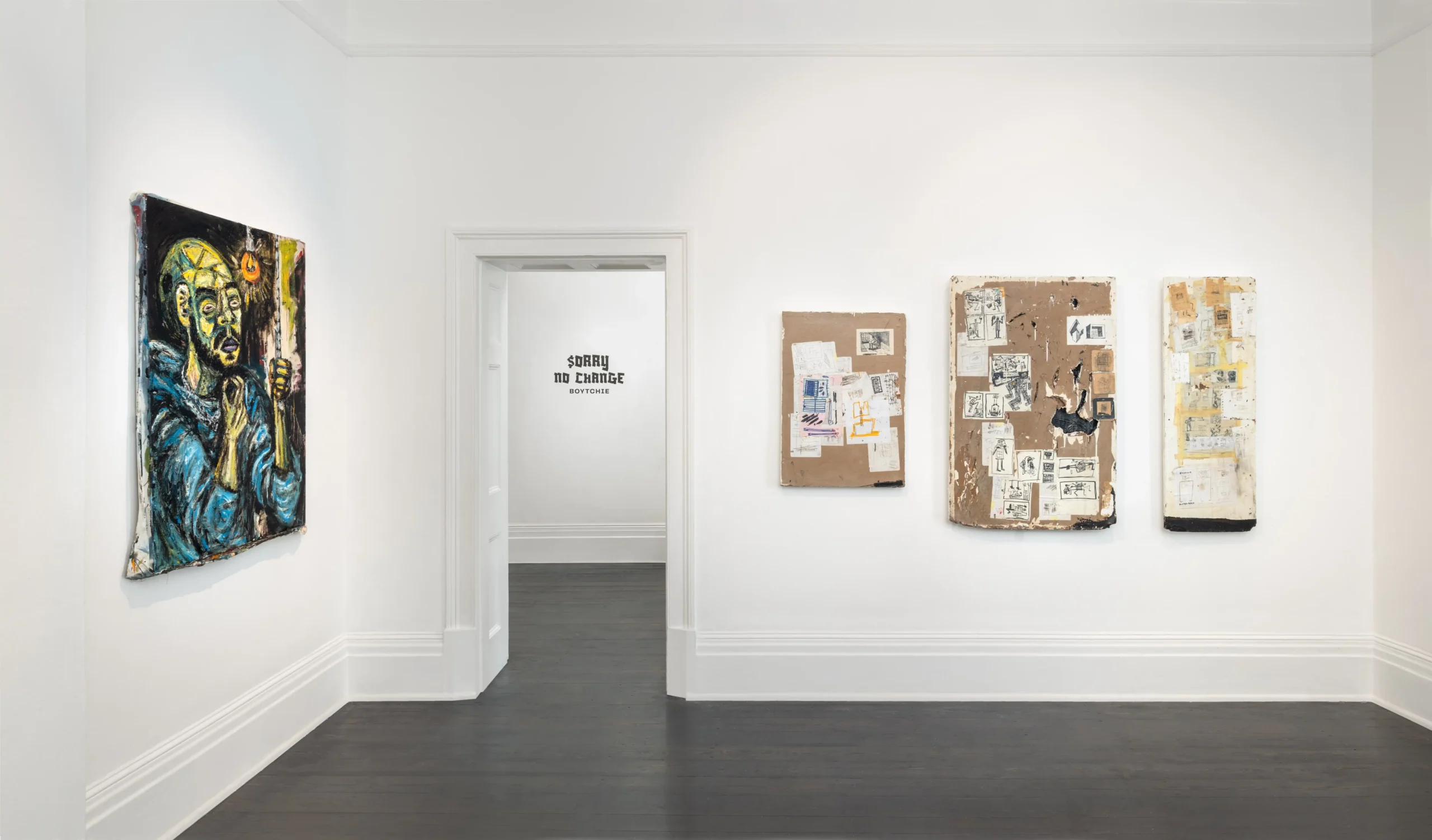
The rough construction of his artworks becomes tethered to a nihilistic material world where figures scratch across the canvas. They hold bags of unknown spoils, guns pointing to our actions and landscapes broken in their foundations. RAKS ON RAKS 2 shows a figure scaling a self-built tower, and perhaps this is the world we are building in Boytchie’s narration? It is tall, slender and unstable in its narrow foundations. The painting UNTITLED (HUSTLER 2) features an eerie smile that taunts us whilst holding a knife to our throats. Is this the world he narrates? Does this world carry violent intentions where greed means to slit the treasures we carry? I felt very restless when experiencing the cynicism of the exhibition, where my tangible greed became apparent, and I felt like a subject in distress, mirroring the figures tormented in a landscape grounded in despair. His pursuit of discomfort allocates us the time to survey each artwork with a sense of anticipation, whilst we clutch our actions and walk through the gallery.
M: How do your recurring motifs, such as skulls, guns, and money, function symbolically in your work beyond surface-level impact?
B: ‘momento mori’
– a latin phrase that translates to “remember you must die” which is what the skulls represent. Symbolising the inevitability of death. And the beautiful thing about death is that it reminds us just how meaningless the possessions we are willing to kill for are. Guns are associated with violence. The double-barreled representation of guns is to protect and to oppress. The guns in my work signify the violence that aids oppression; after all, the only way these systems stand firm is if supported by violence.
Money is also a recurring motif. This is the very thing that makes the world go round, and it just makes sense for the subjects in the series to fight over this thing. Money is freedom in our world. Your quality of life is great when you have access, and that is what money does: it gives you access to everyday needs: shelter, fuel, medication, clean water, nutritious foods and the ability to enjoy what the world has to offer. You’re not a victim of circumstance with money. We view money with admiration, and we lust after it, because we chase it nonstop. That’s hustle culture. It will be the death of us, but before we die, we must eat.
M: Why do you think the distortion of figures, space, or reality is essential to how you tell this story?
B: Because as ‘perfect’ or rather “functional” our world looks, our experience of it says otherwise. It’s a distorted experience. We are basically being catfished, thinking it’s all that. I wanted the world of KA$H OUT to be a warped mirror reflecting our reality. If a person’s humanity is lost, what do they look like? I thought about this and decided that the mirror should reflect deformity, skeletal creatures, greedy eyes, jagged teeth – always hungry for more. Like you’ve lost your soul, your essence, your humanity. You’ve lost what makes you, you. So you’re like us but not in the way that matters. Our skeletons roughly look the same and are somewhat not “special” in identity, I guess. The viewer can then also see themselves in the different subjects of the paintings.
M: What is the “pursuit” that your characters are engaged in, and how does it mirror or mock real-world desires?
B: The subjects in my work are all out for themselves – mirroring what I see in the world at large. Selfishness. And I wanted it to look menacing and vile. In the work, when these figures are in proximity to material possessions, I wanted the audience to see what they might look like, especially when these things are acquired by means of theft and hurting others.
BOYTCHIE
UNTITLED, 2025
OIL, ENAMEL AND BITUMEN ON WOOD
25 1/8 x 22 3/8 x 3 7/8 in. (64 x 57 x 10 cm)
Courtesy of the artist and Everard Read
Photographed by Nirel Sithole
BOYTCHIE
RAKS ON RAKS 2, 2023 – 2025
OIL, ENAMEL & BITUMEN ON CANVAS STRETCHED OVER
BOARD
39 1/4 x 13 3/8 in. (100 x 34 cm)
Courtesy of the artist and Everard Read
Photographed by Nirel Sithole
The overall intensity I experienced emphasised a sense of uniformity circumscribed by colour and culture. The specific stylistic character of each artwork extends the plot of the exhibition into a lonely endeavour, whereby there is an existential isolation of the contemporary hustler. It shows us that sometimes we cannot get away from the people we don’t like because they pay for our time. Boytchie presents us with close-up portraits of seemingly dead individuals, pushing us so close to death that we feel the chill of their bodies. The neo-expressionist agenda is evident in the figures we interpret, as they confess to their mortality through the mobility of enamel and bitumen provided by the artist. Boytchie saliently emphasised that it is our collective actions as an audience that could bring about the purification of systems of oppression. The exhibition addresses the renunciation of material wealth and the dissemination of knowledge about the systemic structure of cycles of destruction. He provides us with a chance to acknowledge the intraviolent nature of the way in which monetary value is distributed. Local-centric truths, within this exhibition, become accountable as the symbolic language the artist provides us with describes an inevitable truth which becomes invulnerable to change. Boytchie’s carved dominoes remind me of his early career, where he gave them out to connect with others. Seeing them for sale now becomes a capitalistic nod, perhaps founded in greed, given the context of the gallery system. I believe the artist is surviving by describing it as a means to thrive under capitalism. The artist explained that the situation is jarring, as kindness must be sold to achieve freedom in one’s pockets. The dominoes cannot be displayed within the exhibition setting; instead, they sit at the front desk, awaiting purchase. This is due to their commodification and the potential for theft, which notes the vulnerability of art objects when value teases the morals of others.
M: Are there artists or movements (past or present) that influence the way you create or think about dystopia?
B: Oh yes, I love Abstract-Expressionism, Neo-Expressionism, and I am definitely inspired by these artists’use of mark making, colour and political critique. The work just speaks about something beautifully. Jean-Michel Basquiat, Leon Golub, Philip Guston, and Cy Twombly are great examples. Artists who influence me to create are more local. Dumile Feni, Peter Clarke, Simphiwe Ndzube, Thando Phenyane, Kamva Matuis, Warren Maroon, Jakinda Boya, Alka Das, Kamyar Bineshtarigh, Lwandiso Botozo, Brett Seiler, Terence Maluleke, Igshaan Adams, Njabulo Hlope, Stephané Conradie….eish way too many toname. I look at these artists’ work and I think FUUUUCK, I need to PUUUUUSSSHHH.
Although the artist is frightened of death, which he admits to with honest words, the exhibition carries a scent of decay, whether through the canvases that are falling off their wooden skeletons or the twisted frames which seem to rot beside the paintings. This is not the stench of an exhibition idle in its meaning but a smell of something asking us to question our positionality within inherited systems such as capitalism and lingering colonial greed. He prompts our eyes with symbolic motifs that dare us to look twice whilst we hold our breath. Our heads brave the bombardment of spoiled imagery to survive in the present so that we may tell the tale of how we, too, have no spare change left to give.