”
Written byRowallan Roy
”
Images byNqaba Mnyameni
Getting to know the “King Of The Underworld”.
A few months ago, I realised I had lost Esinako. Fast friends become slow friends, new-city-friends, with different numbers and social media personas reborn, often transmuting without our notice. I attempted to track her down, remixing old Instagram handles like a witch with a glitching cauldron of nostalgia. It was only when I gave up entirely, embracing defeat, that the King of the Underworld rose to meet me.
I recently had the pleasure of interviewing Esinako Ndabeni on her upcoming EP, King of the Underworld. The musician has gifted us with two singles thus far: ‘BIG BAD WOLF‘ & ‘Riverside Song‘, produced by the iconic Spoek Mathambo. ‘Uyagula‘, her third single, dropped on Friday, December 5th.
“I attempted to track her down, remixing old Instagram handles like a witch with a glitching cauldron of nostalgia. It was only when I gave up entirely, embracing defeat, that the King of the Underworld rose to meet me.”
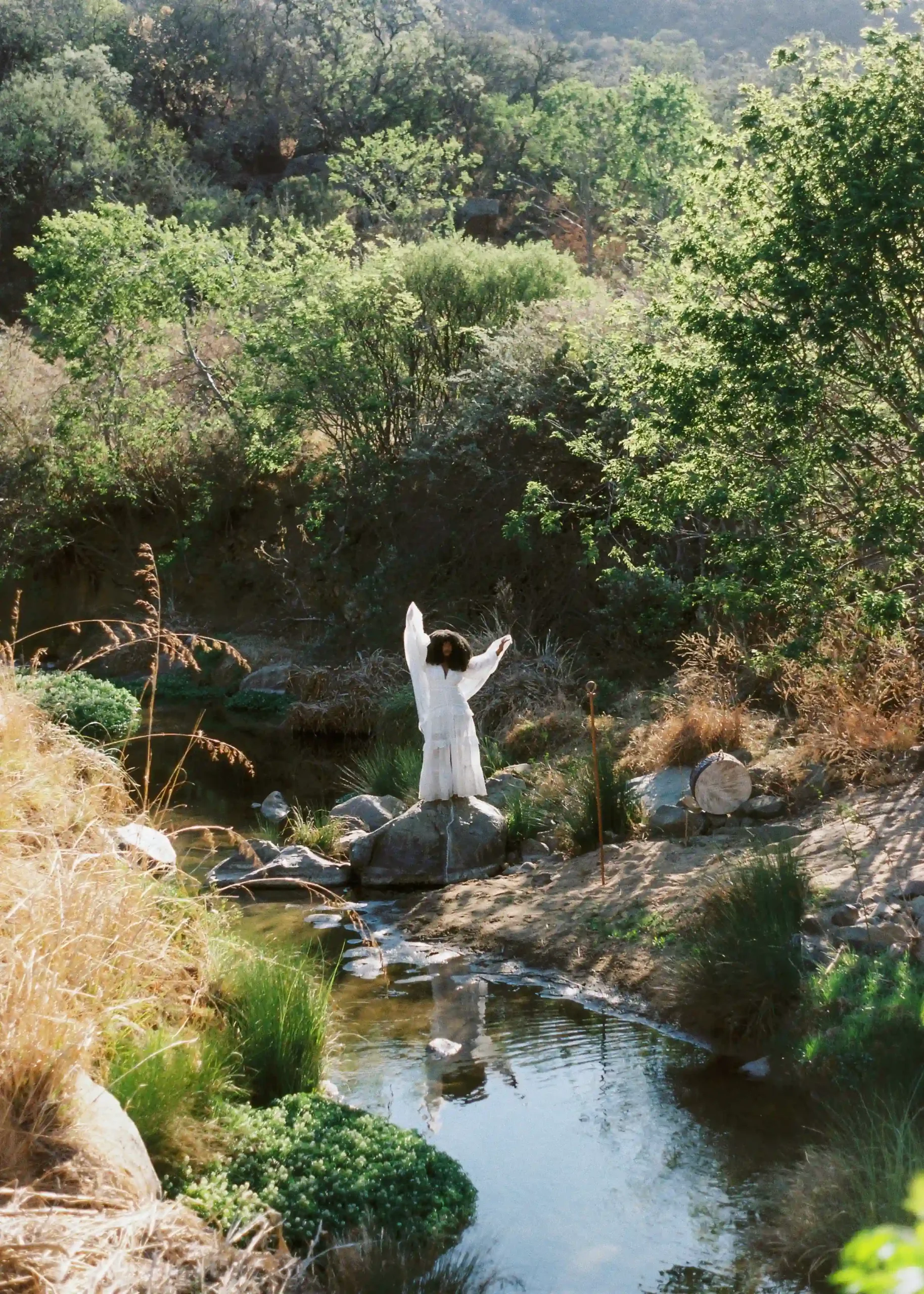
“I need it to haunt,” lingers from our initial video call regarding Riverside Song. Part instruction, intuitive desire, and reflection: offered to Spoek Mathambo when the two first collaborated on the proposed alchemy of her upcoming EP. The song title pays tribute to Esinako’s intimate connection to nature: “I was trying to get myself together, hiking in Newlands forest, when I found myself chilling by the river. And I started singing.”
With the release of Riverside Song, she reflects on her own journey through the underworld, utilising Greek mythology as the first layer of exploration, likening herself to the princess of spring, Persephone. Like Persphone, the musician emerges with gifts and a newfound understanding after her tumultuous transformation. She notes on her Instagram page, “After years of confronting addiction, suicidality and generational curses, I emerge crowned by the underworld to sing the songs my ancestors have been whispering to me.”
‘Riverside Song‘ certainly haunts. The melody is otherworldly, ghostly, yet (un)comfortably familiar and intimate. The singer’s profound lyricism dwells within a raw honesty, an unmasking of the self, tenderly enveloped by Esinako’s throat singing and ethereal humming. She calls upon the listener to lift the veil between fragile egos, insecurities and truth through her own shadow work, “My voice was a thing that came out of me, doing a lot of spiritual work, and working with my distorted ego. Because I didn’t sound like Beyoncé, I felt I shouldn’t sing. Or because I couldn’t write like Jamila Woods, I shouldn’t write.”
Her struggle is profoundly resonating. However, instead of avoiding the distorted ego, she conjures her insecurities. Esinako allows them to bubble to the surface, sitting with them as gifts, rather than curses. Within African Ancestral spirituality, she peels back another layer, “The underworld symbolises the Ancestors who live in the ground below. This means that to connect truly with the ancestors, one must connect with that which is unseen — subconscious fears, addiction, pain — to embody the fullness of their being.”
“My voice was a thing that came out of me, doing a lot of spiritual work, and working with my distorted ego. Because I didn’t sound like Beyoncé, I felt I shouldn’t sing” – Esinako
Hers is less world-building and more world-revealing. Multiplicity appears synonymous with Esinako: a writer, spiritual healer, Sangoma and now musician. She co-authored Born to Kwaito: Reflections on the Kwaito Generation with Sihle Mthembu, recently launched the exciting literary zine, RIOT ZINE and released an experimental eco-memoir and manifesto titled Sacred Earth Philosophy, the latter of which explores themes of history, spirituality and ecology through the lens of her experience as a Sangoma and anthropology-scholar-dropout. All these endeavours have led to her music. Simply put: Esinako is more than a little impressive. And her message is deeply needed.
I commented on the intersection of her past and present work, the critical, literary and spiritual tapestry of it all, to which she responded, “I honestly feel a bit self-possessed. But I’ve been dealing with, you know, when Florence [& The Machine] goes, I need my empty halls to echo with grand self mythology, and there’s been this echoing. It’s batshit,” she laughs. She professes clarity and knowledge of the self as her gospel, and by proxy, we are inspired to do the same.
‘Riverside Song‘ and ‘BIG BAD WOLF‘ are available on all major streaming platforms. She has released music videos for both singles, directed and produced by the talented Nqaba Mnyameni (@hoodpixels), now available on YouTube.